
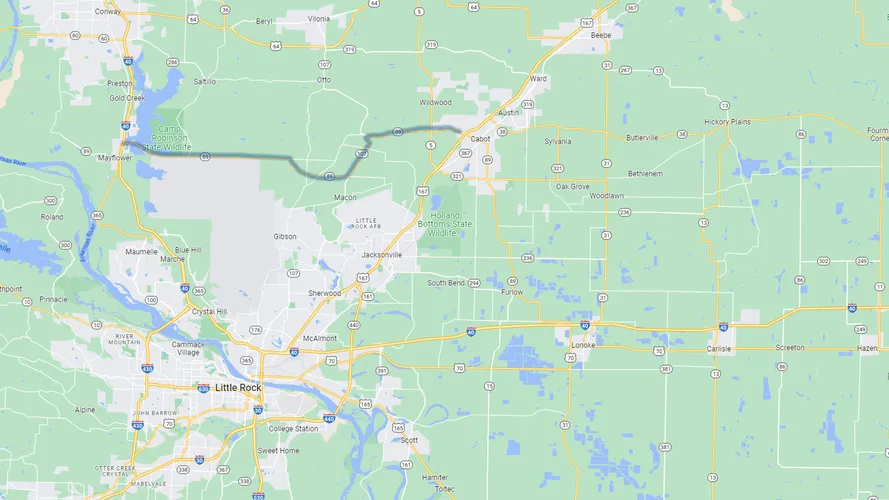
Driving Arkansas Highway 89 from Cabot to Mayflower is a journey through the scenic heart of central Arkansas, where rolling farmland meets piney woods and military history brushes up against small-town charm. This 25-mile route isn’t just a point A to B connection — it’s a winding tour of rural roads, old alignments, and hidden bits of central Arkansas geography that many travelers miss.
We begin our journey in Cabot, a growing community about 20 miles north of Little Rock. It’s a commuter town for many who work in the metro but enjoy a slower pace of life. Arkansas Highway 89 kicks off right at the interchange with Interstate 57. As we leave Cabot behind, the highway quickly shrinks into a two-lane road, trading stoplights and subdivisions for open pastureland and the occasional roadside stand. You’ll spot places like Tates Mill and Sayles — not big towns, but dotted with homes, farms, and the kinds of churches and volunteer fire stations that anchor rural life.
Highway 89 takes a brief pause just a few miles west of Cabot. Here, it ends at an intersection with Arkansas Highway 107, but we don’t stop. To follow the historical routing, we turn south on AR-107 for a short distance before shifting westward again on Republican Road — a Pulaski County highway that locals and long-haul travelers alike often overlook. The road’s name, “Republican Road,” might raise eyebrows, but it actually dates back to the historic community of Republican, Arkansas — a rural settlement with roots going back to the 1800s.
As Republican Road continues westward, it meets a traffic circle — a relatively new feature at the junction with Jacksonville-Conway Road. We swing through the roundabout where Republican Road merges with Jacksonville-Conway Road and keep heading west until the road ends at Sayles Road, right at the Pulaski-Faulkner county line. At this junction, the route picks up the Arkansas Highway 89 designation once again, and we’re officially back on the state highway system for the remainder of the trip.
From here, AR-89 runs along the northern edge of Camp Robinson — a massive training facility operated by the Arkansas National Guard. Though not accessible to the public, Camp Robinson’s boundaries dominate this stretch of the route for the next several miles. The road curves gently through pine forests and open meadows, creating a surprisingly quiet buffer from the more developed areas just to the south. There’s a sense of seclusion here that’s hard to find elsewhere so close to the Little Rock metro.
As we approach Mayflower, we re-enter a more developed corridor. The road crosses Lake Conway, one of the largest man-made lakes in the nation built by the Arkansas Game and Fish Commission. It’s a popular spot for fishing, birdwatching, and low-key boating, and you can often spot locals casting lines from the bridge or the occasional kayak paddling along the shore.
Entering Mayflower proper, Highway 89 intersects with Interstate 40 — a major east-west route that bisects Arkansas. At the time of this recording, the highway used the original overpass to cross I-40 before ending at Arkansas Highway 365. However, as of September 2023, that overpass has been demolished and replaced with a newly constructed bypass. The change reflects Mayflower’s push to reduce congestion through town, and it slightly alters the flow for travelers heading toward Conway or back east toward Little Rock.
Whether you’re following the historical alignment or the updated route, this drive offers a mix of pastoral charm, subtle topographic changes, and insight into the kind of infrastructure evolution that shapes small-town Arkansas. It’s more than a connector — it’s a reflection of how these towns grow, change, and stay rooted all at once.
🗺️ Route Map
0 Comments